Ancient Man from a Biblical Perspective
Author
Shannon Skaer

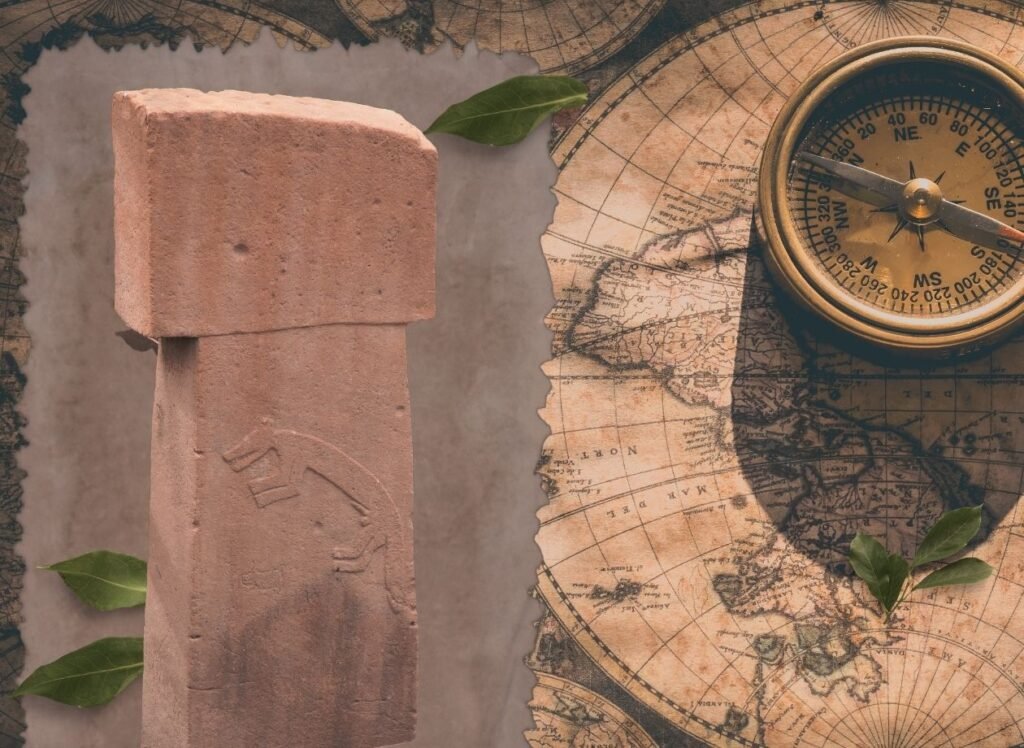
Did your ancestors have the IQ of a toddler?
Have you ever noticed that our expectations for ancient man are similar to those for a toddler?
Hear me out:
1. They aren’t allowed to use power tools.
2. They can’t be motivated by practicality.
3. They must believe in Santa Claus and bogeymen under the bed.
Yes, I know, it sounds weird, but let’s look at Gobekli Tepe. Discovered in 1994, this site in modern-day Turkey was probably built not long after Babel. It’s a large site, and we’ve uncovered 5-10%, which is quite enough for us to know everything we need to know about these people – given how much we’ve already assumed.
The rules for toddlers – er, people – living during this time period are strict. They are can’t live in towns, build structures, farm, or do anything else reasonably permanent, unless you count decorating caves. And even cave paintings must be superstitious in nature.
Ancient man isn’t allowed to use power tools.
Not at all. However, toddlers have a mind of their own. These people decided to quarry megaliths of up to 16 tons, and transport them a quarter mile to a site we now call Gobekli Tepe. There the stones were used to make circular buildings 30 to 100 ft in diameter. Since they weren’t allowed any engineering knowledge or tools, we must expect that it took 500 people to build one of these structures.
No one person with wealth or power hired them to do this, because “toddlers” have no organizational skills and don’t care about money. Instead, they were motivated by a common fear/superstition.
When the structure was complete, they wasted valuable time that should have been spent hunting and gathering in making terrazzo floors for their new building. Terrazzo is made of burnt limestone and clay, polished to give it a spotted appearance. It creates a flooring surface that is extremely durable and resistant to moisture. We can assume this was accidental/superstitious.
Ancient man is never motivated by practicality.
The tiny piece of Gobekli Tepe we’ve excavated has turned up Northern Mesopotamia’s largest collection of grinding stones for cereal. Around 7000 of them. Odd, since we know for sure that they didn’t farm, because toddlers of that period just didn’t farm. And the sickles we found were probably. . .
Um. . .
. . . actually, we have no idea why they were playing with sickles, since the first evidence of agricultural production appears a thousand years later. It all just goes to confirm our early assumption that these people were sadly impractical.
Ancient man must always believe in Santa Claus and bogeymen under the bed.
Now it gets really weird. These people decided to decorate their no-practical-use-buildings. Here we observe the one subtle difference between ancients and toddlers. While they can’t build or make anything practical, their art must be for practical (ie. superstitious) purposes only. Their art wasn’t the crayons on walls type, either. It’s more like… this:
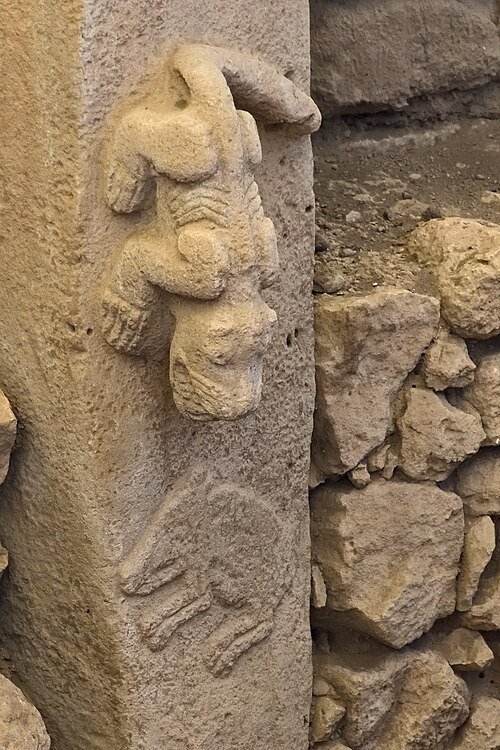
(BTW, we’ve decided that thing going after the boar is a large cat, because the evolutionary timescale we’ve put this site on doesn’t give us any other options.)
Not bad for toddlers. Probably they did all this to stave off evils through some form of magic representation, like a voodoo doll. I mean, that’s why you have pictures on your walls, right?
We’ve decided that Gobekli Tepe was a purely religious site. That’s why we call it “The World’s First Temple.” They couldn’t have lived there because toddlers don’t like to sleep in proximity to bogeymen. Besides, you can’t live for any length of time in one place without agriculture, which we’re sure they hadn’t invented, and they also didn’t have enough water. Our exhaustive digs have uncovered a carved channel that collected rainwater from the surrounding area and fed it into cisterns that could store at least 5,300 cubic feet of water, but what’s that among 500+ worshipers we’ve decided were involved? A puddle. Not enough to wet their whistles.
So there you have it, folks! Everything you ever needed to know about your ancestors (or at least your ancestor’s cousins,) deduced from the world’s oldest religious site and a handful of preconceptions. It’s as easy as A. B. C.
Only we know for sure they didn’t have a written language. . .
If you enjoyed my (admittedly snarky) article, let’s stay in touch! Sign up for my newsletter and get a free ebook, updates, and articles like this one delivered to your inbox each month!
Free Ancient History Short Story
Download a free ebook
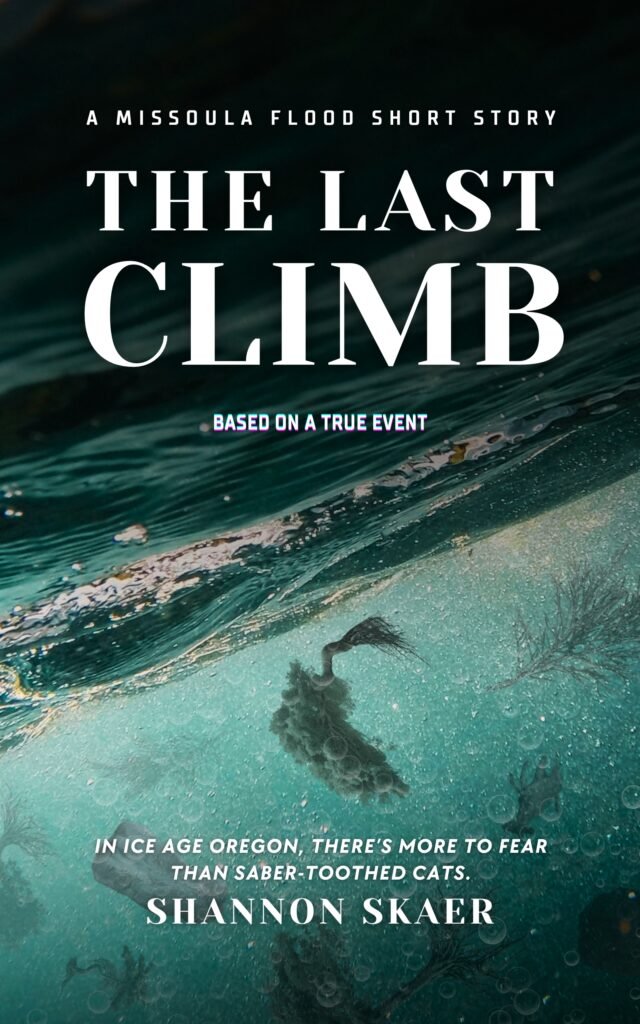
In the fading days of the Ice Age, a monster is unleashed. The Last Climb is a pulse-pounding, bite-sized tale of survival based on one of history’s greatest floods.
When young Chief Tupak feels the ground shake beneath his feet, he knows something is terribly wrong. The great river is not just rising—it’s coming, a wall of water taller than the trees, faster than an arrow in flight. As an unstoppable deluge crashes toward his village, Tupak must make an impossible choice: follow the advice of the past or forge a new path before the water swallows them all.
Inspired by real catastrophic geology, The Last Climb is a gripping survival story that echoes the legacy of the global flood. With the article What Was the Missoula Flood by Michael Oard, this snapshot of the apocalyptic disaster that shaped the landscape of the Pacific Northwest will be hard to forget.
work in progress:
A one-world government rises from the wilderness. This is the story of the Tower of Babel.
100 years after Noah’s flood, Tasha fights for survival, desperate to be the hero who saves her friends. But what if she’s the villain?

About
Meet the author
One of my favorite books as a kid was The World’s Last Mysteries by Reader’s Digest. It chronicled “ancient civilizations, archaeological discoveries, unexplained catastrophes, and other mysteries from man’s past.” Or, in other words, exactly the kind of thing I geek out over. As an author of historical and science fiction, I enjoy exploring forgotten peoples and vanished places from a Christian worldview informed by creation science.
Rules: no paranormal. No aliens, Bigfoot, or Nephilim. Yes to dinosaurs, DNA analysis and improbable possibilities.
-
Archaeologists unearth more than bones on Henderson Island
You and I know he wasn’t actually the last person, but he didn’t know that. He had every reason to believe he was the only human left, and he knew what extinction meant. After all he’d seen several species that once inhabited his barren little island go extinct. On the Pacific Ocean’s Henderson Island lies a heap…
-
The Mysterious Lake of Human Bones in Remote India
In 1942, a forest ranger discovered a lake full of human bones high in the Himalayans. And when I say Roopkund Lake is full of human bones—the remains of around three hundred people rest in the lake water. The area is remote. Before a lake packed with dead folks was discovered, the only people who…
-
Man Chasing Chicken Discovers Ancient Underground City
In 1963, a man in Derinkuyu, Turkey, couldn’t keep his chickens from disappearing. The chickens were kept in an apparently safe location; his basement. No wild animals, no place for the feathered beasts to hide, right? So where did they go? One day he entered the basement in time to see a fluffy feathered rear…
-
How to catch Ice Age Man using Digital Reindeer
What would happen if we assumed ancient man was intelligent? One man did just that, and I haven’t been able to stop talking about it since, which, incidentally, is a substantial reason to have 10 children, all of which you homeschool. Captive audience. Professor John O’Shea is an archaeologist with the University of Michigan, who…
-
Nan Madol: How to Build a City with Charisma (and 750,000 Tons of Stone)
Once upon a time, two brothers landed on an island in the Pacific, and convinced the thousands of people who lived there to forsake their relatively peaceful, low-maintenance life, and devote their energy and time to building Nan Madol, a megalithic city. (Or we can believe the local legend that they built it with the help…
-
Mesa Verde, A Civilization on the Edge
What would induce you to live on a cliff, like the Mesa Verde cliffdwellers did? I’m talking a 600ft drop on one side, and rise of 50-100ft above you. Your family lives in a crack in the stone face, with no water source and no room for a garden. To reach your home, you have…